

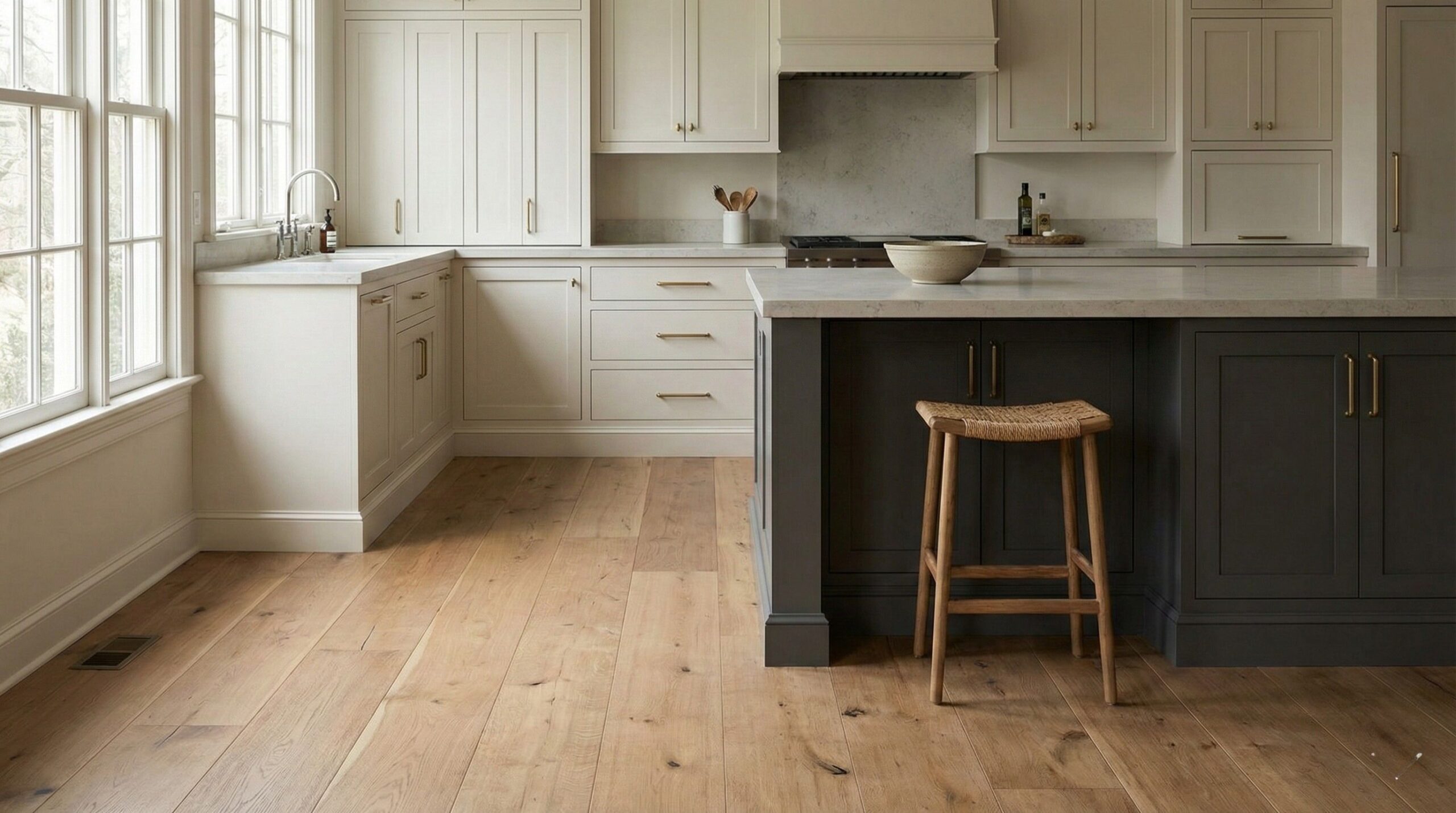
Pairing cabinet finishes with wood floors might seem straightforward, match tones, pick your finish, and move on. But too often that approach leaves kitchens feeling flat, chaotic, or overly stylized. At Haven & Oak, our goal is balance, not mimicry. When textures, tones, and sheens work together thoughtfully, a space feels layered, refined, and effortlessly timeless. Here’s how to make that harmony happen.
1. Understand the Visual Weight of Your Floors
Before selecting any cabinetry, examine your flooring closely:
- Bold floors with knots, wide grain, or dramatic tone shifts demand restraint elsewhere.
- Subtle floors with fine grain and smooth color open the door to more dramatic cabinetry.
The grain variation, color depth, and pattern movement in the floor start the conversation. Think of your floors as the base, not the dominant voice.
2. Calming Bold Floors With Neutral Cabinets
When your floors are busy or highly textured, the counterpoint should be calm:
- Soft neutrals in whites, grays, or warm beige work beautifully.
- Matte finishes absorb light, preventing visual overload.
- Simple door styles with minimal detailing help reduce clutter.
This restrained approach gives your eyes space to rest, while the floors still make their statement.
3. Giving Subtle Floors Some Personality
If your flooring is understated, cabinetry is where you can introduce texture and depth:
- Choose medium-to-deep stains or two-tone palettes such as a darker island with lighter uppers.
- Highlight grain with textured finishes like wire-brushing or UV curing for extra character.
- This layered look allows cabinets to shine without overshadowing the floor.
It’s not about contrast for its own sake, it’s about bringing visual interest where it matters.
4. Avoiding the Matchy-Matchy Pitfall
Matching cabinet tones to floors might seem harmonious but often leads to:
- Flat visual fields that lack contrast or character.
- Showroom effect, clean, yes. Inviting? Not always.
Instead, aim for complementary differences, choose finishes that coordinate without copying. Contrast doesn’t have to be loud; even a whisper of difference can create a sophisticated balance.
5. The Art of Layered Textures & Sheens
Texture and sheen help balance tones, especially in areas with oversized features:
- Matte cabinets + reflective floors provide depth without shine overload.
- Semi-gloss or satin accents, on faucets, island faces, or built-in details, add visual interest.
- Complementary materials, stone countertops, metal hardware, glass, offer an extra layer that ties everything together.
When materials interact purposely, the space feels cohesive, not cobbled together.
6. Principles to Guide Your Finish Choices
Follow these guidelines when pairing cabinets and floors:
| Principle | What to Think About | Why It Matters |
| Tone | Match warm woods with warm cabinet tones; cool undertones with cool paints | Ensures tonal consistency |
| Grain | Balance strong grain floors with smooth cabinets, and vice versa | Prevents pattern competition |
| Sheen | Combine matte cabinetry with contrasting sheens on accents | Adds dimension without excess |
| Accent surfaces | Make your island or hood the standout with layered tone | Focal points anchor the palette |
Start here, and make minor adjustments until finishes complement, not clash.
7. Visual Examples & Before/After Scenarios
Example A
Floor: Reclaimed oak with heavy grain and knots
Cabinets: Soft white matte with minimal trim
Result: The grain dances in the background while the calm cabinets provide structure
Example B
Floor: Light maple with smooth, even tone
Cabinets: Charcoal island with warm white uppers
Result: The island steals subtle focus without creating a harsh contrast
Example C
Floor: Warm walnut planks
Cabinets: Beige base cabinets, light wood island, and brass hardware
Result: A warm, layered environment where finishes dialogue in harmony
These pairings demonstrate how intentional choices breathe life into everyday spaces.
8. Your Guided Approach at Haven & Oak
We simplify the decisions through our proven process:
- Floor assessment during the design consultation
- Curated sample boards featuring cabinet finishes that offset or enhance floor tones
- Side-by-side evaluations of flooring, swatches, and hardware under your lighting
- Refinement and walk-through to ensure finishes sit well in the real space
The result? A kitchen that feels cohesive, not forced.
Final Thoughts
The best kitchen finishes feel natural and layered, never flat or chaotic. Beautiful floors and custom cabinetry are only successful when they complement, not compete. If your goal is a kitchen that feels timeless, thoughtful, and perfectly in balance, start by pairing textures and tones smartly, and the whole space will fall into place.