

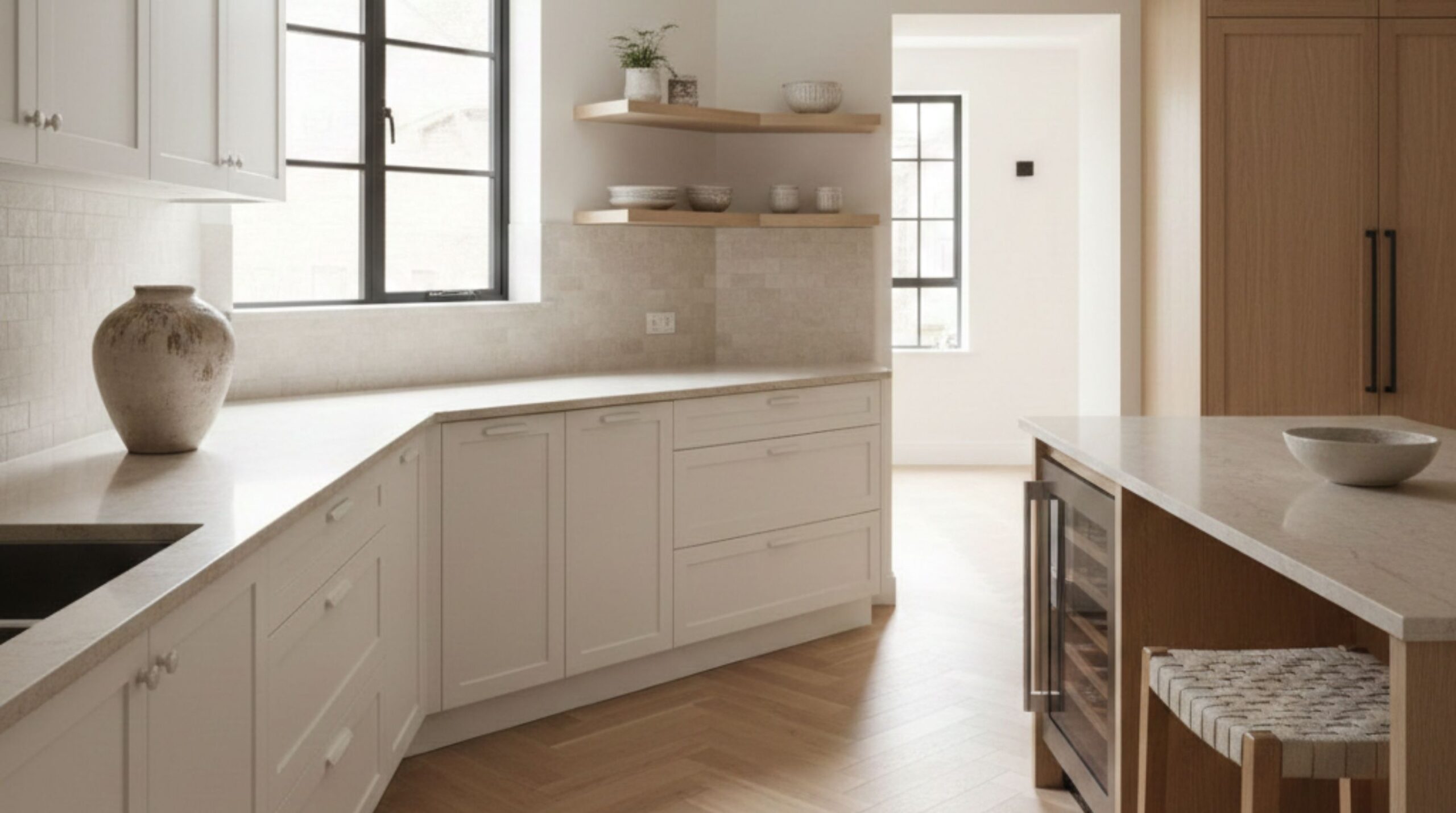
Most people walk into an awkward kitchen layout and immediately start listing everything that’s wrong with it. The wall that cuts in at an angle. The corner that feels unusable. The room that refuses to line up cleanly with the rest of the house. To most homeowners, those quirks feel like limitations.
At DOCI, we see them differently.
Unusual floorplans don’t signal failure. They signal opportunity. The kinds of spaces that force better questions, smarter decisions, and more intentional design. Some of the most functional kitchens we’ve ever built came from rooms that didn’t make sense at first glance.
Because good design isn’t about forcing a space to behave like a showroom. It’s about shaping what already exists into something that works.
Why “Weird” Layouts Actually Lead to Better Kitchens
Perfect rectangles are easy. They rarely require much thought. Cabinets line up, appliances fall into predictable places, and the design almost builds itself.
Awkward layouts don’t give you that luxury.
Odd angles, offset walls, tight clearances, and mismatched room connections force you to slow down. They demand a deeper understanding of how the kitchen will actually be used. Where people walk. Where they stop. Where they gather. Where things tend to pile up.
Those constraints remove lazy design options. What’s left is problem-solving.
And that’s where kitchens start to get good.
The First Shift: Stop Fighting the Room
One of the biggest mistakes we see is trying to “fix” an awkward floorplan by pretending it isn’t awkward. Forcing symmetry where it doesn’t belong. Squeezing standard cabinet runs into spaces that clearly weren’t built for them.
That approach usually creates kitchens that feel tense. Everything technically fits, but nothing feels natural.
Our approach starts with acceptance.
We study the room as it is. The angles. The transitions. The sightlines from adjacent spaces. We ask how the kitchen wants to function, not how a catalog layout would look inside it.
Once you stop fighting the room, design becomes more flexible.
Clean Sightlines Change Everything
In unusual layouts, visual flow matters more than ever. When walls don’t line up cleanly, the eye needs guidance.
That’s where cabinetry plays a bigger role than most people expect.
Strategic cabinet heights, intentional breaks between runs, and vertical elements can quietly organize a space. A tall pantry placed in the right spot can anchor a wall that otherwise feels scattered. A lowered run can preserve openness where a full-height cabinet would block the room.
Instead of trying to make everything match, we focus on making everything relate.
When the eye knows where to land, the space immediately feels calmer.
Turning Tight Corners Into Functional Zones
Tight corners are usually written off as dead space. But they’re often some of the most valuable real estate in a kitchen when handled correctly.
Rather than stuffing a standard cabinet into a corner and hoping for the best, we design around behavior. What happens there? Is it a pass-through? A pause point? A storage need that doesn’t require daily access?
Custom corner solutions, angled drawers, or even intentionally leaving space open can improve flow far more than forcing extra storage.
Not every inch needs a cabinet. Sometimes what makes a kitchen work is knowing where not to build.
Zoning Brings Order to Irregular Rooms
Awkward layouts benefit from clear zones more than perfect ones do.
Instead of thinking in straight lines, we design kitchens in functions. Prep. Cooking. Cleaning. Storage. Each zone is placed where it makes the most sense for movement, not symmetry.
In irregular rooms, this often means breaking from tradition. A prep zone might live where a dining nook once was. Storage may shift away from the main run to keep traffic clear. Appliances might stagger rather than align.
When zones are clear, the kitchen feels intuitive, even if the room shape isn’t.
That’s the difference between a kitchen that looks right and one that feels right.
Custom Storage Solves What Layouts Can’t
Standard cabinets assume standard rooms. Awkward layouts are rarely standard.
This is where custom storage becomes more than a luxury. It’s a necessity.
Shallower cabinets in tight walkways prevent congestion. Vertical storage makes use of narrow wall segments. Drawer configurations adapt to angles instead of ignoring them. Built-ins replace wasted gaps.
Every adjustment compounds. The more the storage responds to the room, the less the room feels awkward.
The goal isn’t to add more cabinets. It’s to add the right ones.
Why These Kitchens Feel Better When They’re Done
The most telling moment comes after installation.
Clients walk into the finished space and say the same thing: It feels natural now.
Not perfect. Not trendy. Just right.
That’s because the kitchen wasn’t forced into a template. It was shaped intentionally, respecting the room instead of overpowering it.
Awkward layouts don’t disappear. They evolve. And when handled well, they produce kitchens that feel more thoughtful than anything built in a perfect box.
The Real Advantage of “Impossible” Spaces
We love weird layouts because they don’t let us coast. They require attention. They demand clarity. They reward intention.
Those spaces push design to do what it’s supposed to do: solve problems quietly and beautifully.
Because the goal was never to fight the floorplan.
It was to turn it into something that finally works.